SILVES
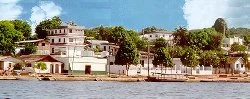 The municipal of Silves is located 300 km from Manaus, down
the Amazon River in an area surrounded by lakes of different sizes and shapes.
The municipal of Silves is located 300 km from Manaus, down
the Amazon River in an area surrounded by lakes of different sizes and shapes.
This aquatic ecosystem is as rich as it is delicate. It is delicate in terms of the biological mechanisms which regulate the life of plants, animals and the traditional riverside communities, known as "ribeirinhos", who for centuries have lived in this region, respecting the balance between the environment's vital requirements and natural resources.
Silves is located in a beautiful island 300 km downstream the Amazonas River from Manaus. Silves is at the junction of the Urubu River and the Canaçari Lake, in addition to its renowned abundance of fish and aquatic life.
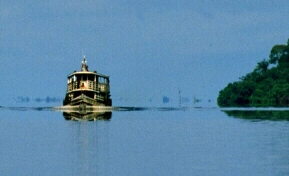 The Canaçari has a valuable asset: its breathtaking landscape. Being geographically equatorial located at parallel 03º50', South latitude and meridian 58º15' West longitude.
The settlement, that originated the city, occurred in 1660 with the foundation of the Mission of the Saracá (name of one of the lakes that borders the island of Silves), by Father Raymond of the Mercês Order. This mission also included the current City of Itapiranga (today neighboring Silves City). In the beginning of its foundation the City was stage of bloody fights between aboriginal and the Portuguese colonists. In 1663 it occurred, in the neighborhoods of the estuary of Rio Urubu, a great battle that resulted in the death of thousand of indiums and Portuguese.
Only with the inbound of the colonist Pedro da Costa Favela, which disembarked in the region in December, 1963, followed by a numerous troop, the fights had ceased. In 1759, with the maintenance of the order, the small Village of Saracá is raised to the category of Village with the name of Silves, being extinct in 1883 and commit in 1852. In 1922, the municipal headquarters were transferred to Itapiranga, being this high town to the category of Village in February of 1925, through the State Decree 23 and the headquarters of the city return to Silves.
 In 1930 it is annexed to the city of commit Itacoatiara and in 1935. In 1938 Itapiranga
starts to call itself as Silves, with headquarters in the village of the same name, raised to the city condition.
In 1930 it is annexed to the city of commit Itacoatiara and in 1935. In 1938 Itapiranga
starts to call itself as Silves, with headquarters in the village of the same name, raised to the city condition.
In this exactly year, has its defined administrative structure in 2 districts: Itapiranga and Silves. In December 29 1956, for the State Law n. 117 had been broken up in stand-alone cities. In December 10 1981, Silves loses part of its territory in favor of the new cities of Rio Preto da Eva and Presidente Figueiredo.
The local economy, the primary sector concentRates the thick one of the economic activities, with prominence for cattle and agriculture. The temporary cultures mobilize great part of the agricultural workmanship. It is expressive the productions of: cassava, pineapple, rice, sugar cane, beans, jute, maize and watermelon.
The tourism detaches as great economic source, mainly the ecotourism, that comes receiving an intense investment.